


What is HNI category in IPO?
High Net Worth Individuals (HNIs) are Non-Institutional Investors (NIIs) in an IPO. To make a bid, you must put in more than ₹2,00,000 in a single application. This section is for investors who can put in more money than regular investors and agree to a proportionate allotment instead of a lottery-based allotment.
HNIs might be individuals who live in India, NRIs, HUFs, corporations, trusts, and other qualified entities that apply for more than ₹2 lakh. At least 15% of the total issue size in a mainboard IPO is set aside for the NII/HNI category. This gives investors in good issues a chance to get a good deal.

Eligibility rules for HNI IPO application
To apply for an IPO in the HNI category, you must make a single bid of more than ₹2,00,000. To get this amount, you multiply the number of shares you want by the highest price in the price band. There is no limit on the amount of money that can be applied for an HNI, hence big bids of crores are frequent in popular IPOs.
The applicant needs to have a valid PAN, a Demat account, and a bank account that is connected to the PAN and can be accessed through a broker or bank. HNI applicants can’t use the “cut-off price” option that retail applicants can use. Instead, they have to provide a precise offer price within the IPO price band.
How to pay: UPI vs. ASBA for high-net-worth individuals
Many platforms let HNIs use UPI for IPO applications up to ₹5 lakh, although there is a limit on how much UPI can be used per application. In the standard model, SEBI’s UPI framework limits IPO applications via UPI to ₹2 lakh per transaction. As a result, brokers routinely send bigger HNI sums through ASBA.
HNIs usually have to apply through ASBA for applications over ₹5 lakh. This means that the application amount is held in the bank account until the allotment or refund. Self-Certified Syndicate Banks (SCSBs) offer ASBA through net banking or at their branches. This is the most usual way for large NII bids to get through.
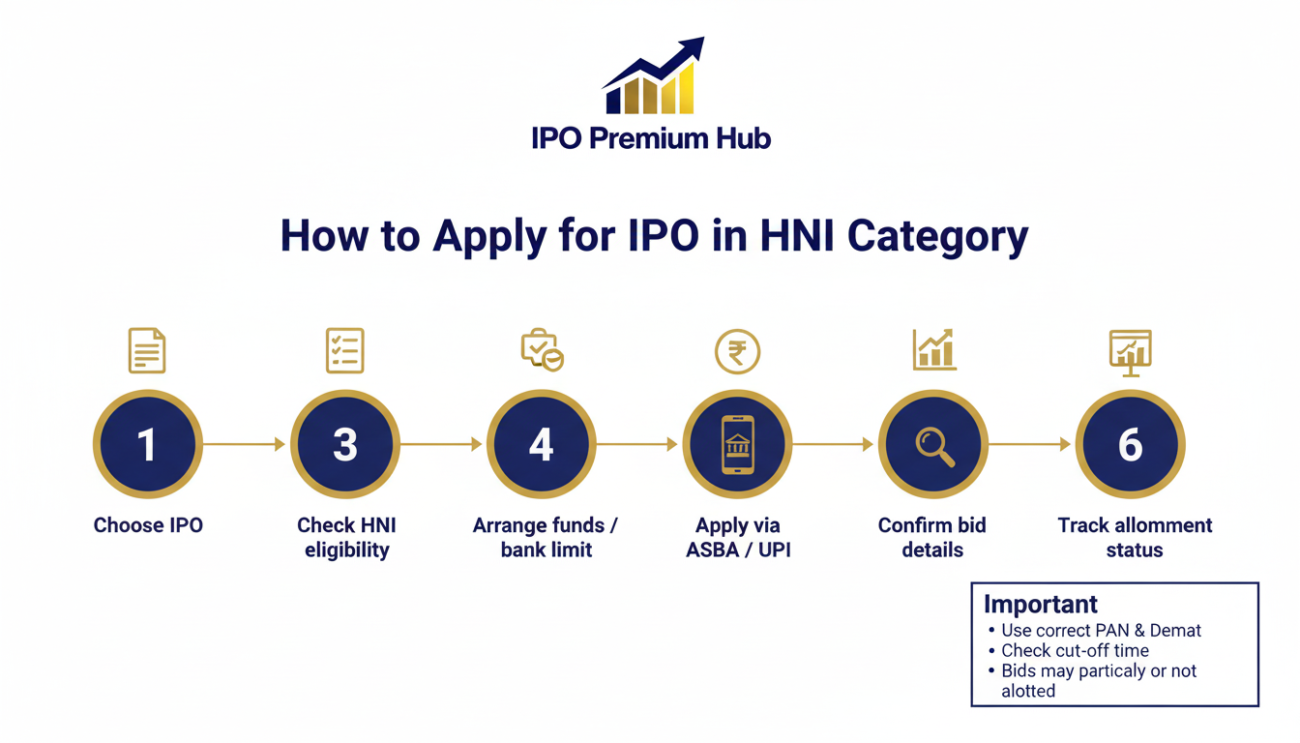
Step‑by‑step: how to apply for IPO in HNI category
-
Open and activate Demat + trading
-
Ensure you have an active Demat and trading account with a broker that supports IPO applications.
-
Complete full KYC and link your primary bank account for ASBA/UPI based blocking.
-
-
Check IPO details and decide amount
-
Review IPO dates, price band, lot size and NII reservation in the issue prospectus or broker app.
-
Decide your HNI investment amount, ensuring it crosses ₹2,00,000 in a single application after calculating lots and price.
-
-
Log in to broker or bank IPO section
-
Through your broker (e.g., Angel One, Kotak, Groww, etc.), go to the IPO or “Invest in IPO” section.
-
Alternatively, use your net‑banking ASBA menu with supported banks like HDFC Bank and select “IPO Application”.
-
-
Select HNI / NII investor type
-
Choose the IPO you wish to apply for and select “HNI” / “NII” / “Non‑Institutional Investor” from the category dropdown.
-
Remember that once you apply as HNI, the category cannot be changed or cancelled on many platforms.
-
-
Enter lots, price and investor details
-
Enter the number of shares or lots so that the total application value exceeds ₹2 lakh at your chosen bid price.
-
Specify a bid price within the IPO price band, as HNIs cannot tick the cut‑off option used by retail investors.
-
-
Choose payment method (UPI or ASBA)
-
For smaller HNI bids where your broker permits, you can enter your UPI ID and approve the mandate on your UPI app.
-
For larger bids (typically above ₹5 lakh), select the ASBA option, where the funds are blocked directly from your bank account.
-
-
Confirm and submit the application
-
Review your IPO name, category (HNI), total bid amount, PAN, Demat details and bank account before submission.
-
Submit the form and ensure you receive an application number or acknowledgement from your broker or bank.
-
-
Approve mandate and track allotment
-
If using UPI, approve the collect request within the time limit to avoid application rejection.
-
After the issue closes, track NII allotment status on the registrar’s website or stock‑broker platform using PAN or application number.
-
Key differences: Retail vs HNI application
Use this table directly in your article to explain category differences:
| Parameter | Retail Investor | HNI / NII Investor (HNI Category) |
|---|---|---|
| Minimum application | Up to ₹2,00,000 per issue | Above ₹2,00,000 per issue |
| Reservation in IPO | At least 35% of issue size | At least 15% reserved for NII/HNI |
| Cut‑off price option | Allowed – can select cut‑off | Not allowed – must specify price |
| Allotment basis | Often lottery if oversubscribed | Proportionate to demand in NII book |
| Payment methods | UPI / ASBA for ≤₹2 lakh | UPI (limited) and ASBA via banks |
| Typical investor profile | Small, retail participants | High‑ticket individuals, NRIs, entities |
Tips to improve allotment chance as HNI applicant
1) Apply early in the IPO window: If you apply on Day 1 or early on Day 2, you can avoid last-minute UPI/ASBA problems and make sure your HNI bid is recorded correctly.
2) Set realistic bid sizes and prices: Look at how many people have bid on HNI problems in the past and stay away from offers that are very little, just above ₹2 lakh, on very popular issues. Bidding at or near the higher price band usually gives you a better chance than low-ball bids.
3) Keep enough money in the bank and get authorization for your mandates: Make sure there is enough money in the associated bank account so that the full application amount may be stopped without any problems. Always quickly approve UPI mandates and check if the application status has changed to “bid placed” or “blocked successfully.”
4) Think about several qualified Demat accounts: Some high-net-worth individuals (HNIs) distribute their bids among the Demat accounts of family members who have various PANs. This keeps them within SEBI guidelines while also increasing their chances of getting an allotment. Don’t ever submit more than one HNI bid from the same PAN in the same category. These applications could be turned down.

Mr. Nadim Abbas M G is an Intermediate Chartered Accountant with a strong background in Information Technology. He combines his expertise in IT with a deep understanding of the stock market, making him a valuable resource for both financial and technical insights. With hands-on experience in accounting, IT systems, and stock market analysis, Nadim excels in bridging the gap between finance and technology, offering strategic advice and expert guidance in both domains.


